
- Browse Category
Subjects
 We Begin at the EndLearn More
 - Choice Picks
- Top 100 Free Books
- Blog
- Recently Added
- Submit your eBook
- Browse Category
We Begin at the EndLearn More
- Choice Picks
- Top 100 Free Books
- Blog
- Recently Added
- Submit your eBook
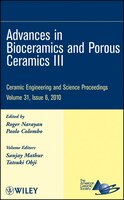
Advances in Bioceramics and Porous Ceramics III: Ceramic Engineering and Science Proceedings, Volume 31, Issue 6
2020-12-29 07:40:40
This issue contains the proceedings of the “Porous Ceramics: Novel Developments and Applications” and “Next Generation Bioceramics” symposia, which were held on January 24-29, 2010 at the Hilton Daytona Beach Resort and the Oc...
Read more
This issue contains the proceedings of the “Porous Ceramics: Novel Developments and Applications” and “Next Generation Bioceramics” symposia, which were held on January 24-29, 2010 at the Hilton Daytona Beach Resort and the Ocean Center in Daytona Beach, Florida, USA.
The interaction between ceramic materials and living organisms is a leading area of ceramics research. Novel bioceramic materials are being developed that will provide improvements in diagnosis and treatment of medical and dental conditions. In addition, bioinspired ceramics and biomimetic ceramics have generated considerable interest in the scientific community. The “Next Generation Bioceramics” symposium addressed several leading areas related to the development and use of novel bioceramics, including advanced processing of bioceramics; biomineralization and tissue-material interactions; bioinspired and biomimetic ceramics; ceramics for drug delivery; ceramic biosensors; in vitro and in vivo characterization of bioceramics; mechanical properties of bioceramics; and nanostructured bioceramics.
The “Porous Ceramics” symposium aimed to bring together engineers and scientists in the area of ceramic materials containing high volume fractions of porosity, in which the porosity ranged from nano- to millimeters. These materials have attracted significant academic and industrial attention for use in environmental applications, an area where ceramics, particularly porous ones, play a key role because of their suitable properties. Therefore, a significant number of contributions, of which some are present in this volume, was devoted to the fabrication and characterization of porous ceramics for gas purification (e.g., H2 separation and CO2 separation) as well as to particulate filtration (e.g., diesel engine soot).
A leading area of ceramics research involves the development of porous ceramics for medical, dental, and biotechnology applications. For example, porous ceramics are under development for use as bone substitutes because a porous structure may enhance tissue ingrowth. Therefore, tailoring of porosity to give specific characteristics, in terms of the amount of interconnecting cells and of the cell and cell window size is required. A joint session involving participants from bioceramics and porous ceramics symposia was therefore held in order to stimulate discussion and productive interactions between the two scientific communities.
Less
Compare Prices
| Store | Availability | Book Format | Condition | Price |
|---|---|---|---|---|
| Indigo Books & Music | In Stock | Hard Cover | Hard Cover | Buy CAD 90.00 |
Available Discount
No Discount available
Related Books
View All
Falter: Has the Human Game Begun to Play Itself Out?

The Book Club
Can't Make This Stuff Up!: Finding the Upside to Life's Downs
Clean & Lean: 30 Days, 30 Foods, a New You!

Life Will Be the Death of Me: ...And You Too!

Twinkle, Twinkle, Little Star (Indestructibles Series)

Diary of an Awesome Friendly Kid: Rowley Jefferson's Journal

House of Shadows: An Enthralling Historical Mystery
The Pout-Pout Fish

The Secret Wife: A captivating story of romance, passion and mystery

Going to School

We Are Not Friends (You Are Not Small)

The Silent Woman (Cat Carlisle, Book 1)

Good Night, Little Blue Truck

The Wonderful Things You Will Be

Feed Your Best Friend Better: Easy, Nutritious Meals and Treats for Dogs

Row, Row, Row Your Boat (Indestructibles Series)

Made for Me

Commander in Cheat: How Golf Explains Trump

Hurricane Season

Secrets Between Us: An absolutely gripping psychological thriller

American Moonshot: John F. Kennedy and the Great Space Race

You Be You: Detox Your Life, Crush Your Limitations, and Own Your Awesome

There Was an Old Lady Who Swallowed a Chick!
Trillion Dollar Coach: The Leadership Playbook of Silicon Valley's Bill Campbell

Settings
Reflow text when sidebars are open.
