
- Browse Category
Subjects
 We Begin at the EndLearn More
 - Choice Picks
- Top 100 Free Books
- Blog
- Recently Added
- Submit your eBook
- Browse Category
We Begin at the EndLearn More
- Choice Picks
- Top 100 Free Books
- Blog
- Recently Added
- Submit your eBook
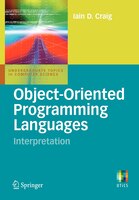
Object-oriented Programming Languages: Interpretation
2021-01-06 01:51:07
1.1 Introduction Object-oriented programming has opened a great many perspectives on the concept of software and has been hailed as part of the solution to the so-called "software crisis". It has given the possibility that software componen...
Read more
1.1 Introduction Object-oriented programming has opened a great many perspectives on the concept of software and has been hailed as part of the solution to the so-called "software crisis". It has given the possibility that software components can be constructedandreusedwithconsiderablymorecredibility.Therearenowmany case studies in which the reuse of object-oriented components has been made and analysed. Object-oriented programming relates the programming activity to that of modelling or simulation; objects are identi?ed by a correspondence with the objects found in the application area of the program and are used to model those domain operations. Object-oriented programming also opens the prospect of more ?exible software that is able to respond dynamically to the needs of the application at runtime. It is very easy to think that object-oriented programming can be performed in only one way. The prevalence of C++ and Java suggests that they are the onlywaytoapproachtheproblemofwhatanobject-orientedprogrammingl- guage should look like. There are many approaches to this way of programming andC++andJavaexemplifyjustoneofthesedi?erentapproaches.Indeed,the wayinwhichtheconceptoftheobjectisinterpreteddi?ersbetweenapproaches and between languages. The two main approaches found in object-oriented programming languages are, respectively, class-based and prototype-based languages. Class-based l- guages are exempli?ed by Smalltalk [34], C++ [75, 74] and Java [47]. This 2 1. Introduction approach is based upon the identi?cation of common properties of objects and their description in terms of a de?nitional structure called a class. The objects manipulated by class-based programs are the result of instantiating classes.
Less

Compare Prices
| Store | Availability | Book Format | Condition | Price |
|---|---|---|---|---|
| Indigo Books & Music | In Stock | Paperback | Paperback | Buy CAD 55.19 |
Available Discount
No Discount available
Related Books
View All
We Are Not Friends (You Are Not Small)

Feed Your Best Friend Better: Easy, Nutritious Meals and Treats for Dogs
Can't Make This Stuff Up!: Finding the Upside to Life's Downs

American Moonshot: John F. Kennedy and the Great Space Race

Hurricane Season

The Silent Woman (Cat Carlisle, Book 1)

Life Will Be the Death of Me: ...And You Too!

Made for Me

Commander in Cheat: How Golf Explains Trump

The Wonderful Things You Will Be
Clean & Lean: 30 Days, 30 Foods, a New You!

The Secret Wife: A captivating story of romance, passion and mystery

Twinkle, Twinkle, Little Star (Indestructibles Series)

You Be You: Detox Your Life, Crush Your Limitations, and Own Your Awesome

Going to School

Secrets Between Us: An absolutely gripping psychological thriller

There Was an Old Lady Who Swallowed a Chick!

The Book Club
Falter: Has the Human Game Begun to Play Itself Out?
Diary of an Awesome Friendly Kid: Rowley Jefferson's Journal
Trillion Dollar Coach: The Leadership Playbook of Silicon Valley's Bill Campbell
The Pout-Pout Fish

House of Shadows: An Enthralling Historical Mystery

Row, Row, Row Your Boat (Indestructibles Series)

Good Night, Little Blue Truck

Settings
Reflow text when sidebars are open.
